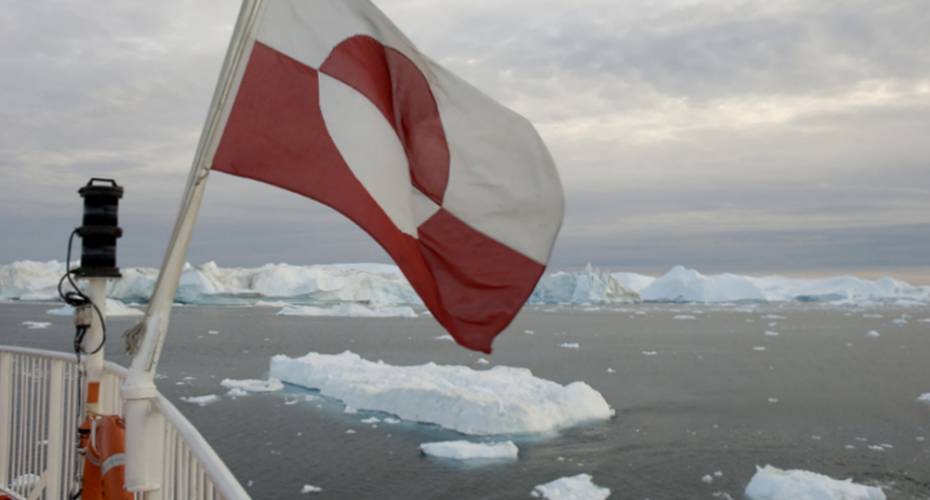
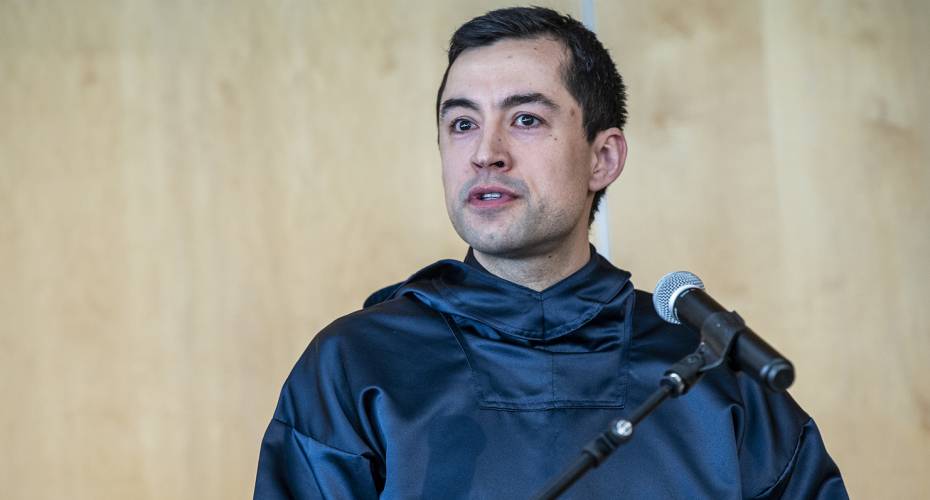
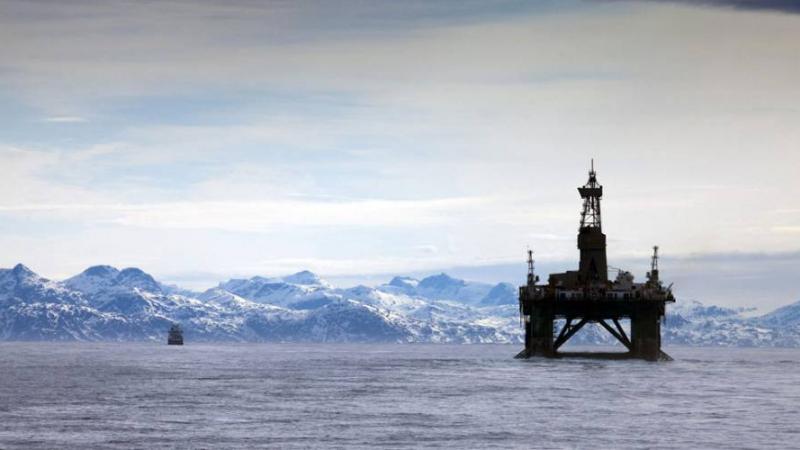
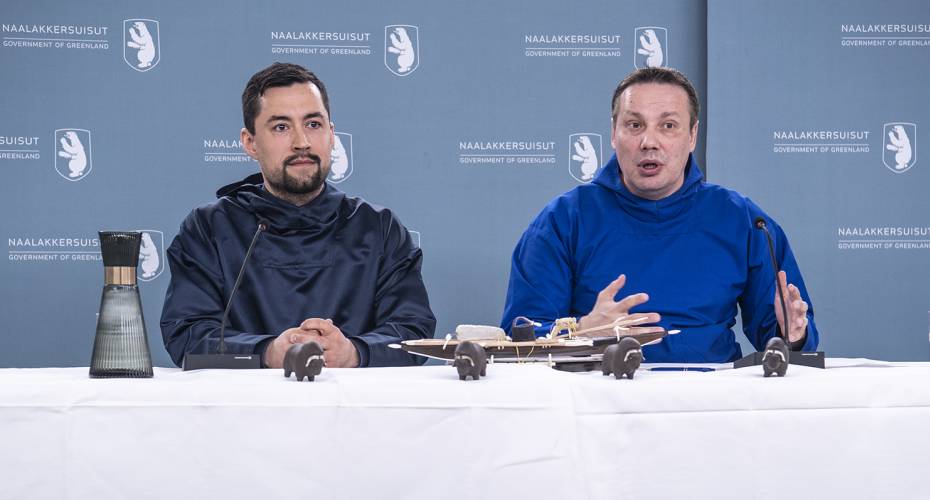
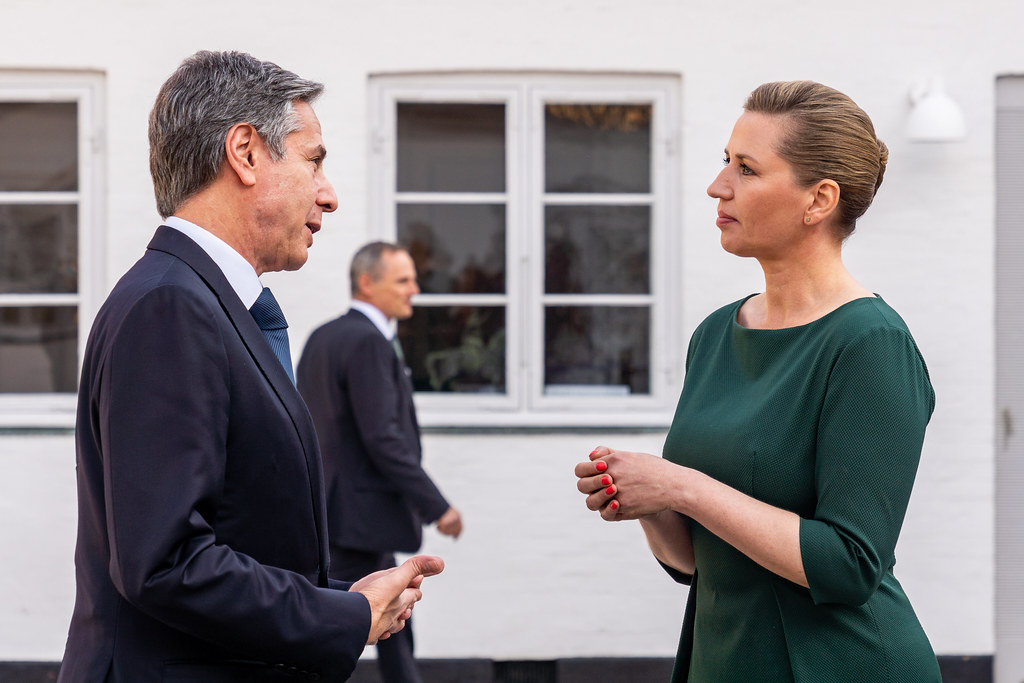
As Donald Trump reiterated his desire to take over Greenland on the sidelines of his inauguration speech, Secretary of State Marco Rubio declared that the US President’s interest was “no joke” and a matter of “national interest” (Altinget, January 21; Eye on the Arctic, January 31). Donald Trump Jr.’s recent visit to Nuuk has put Greenland even more in the international spotlight. As a sign of unity, Greenland Prime Minister Múte B. Egede called for the Greenlandic flag to be raised on January 24 (Sermitsiaq, January 24), while he had repeatedly stressed that the island belonged to Greenlanders and was not for sale, that they would decide their own future and that they remained faithful to their quest for independence (KNR, January 8). This is what he hammered home during his appearance on the ultra-conservative US Fox News channel: “We don’t want to be Americans, and we don’t want to be Danes either. We will be Greenlanders,” he declared (Sermitsiaq, January 17). Echoing this, Danish Prime Minister Mette Frederiksen asserted that “Greenlanders must decide for themselves on the future of Greenland” (Berlingske, January 7), a point she reaffirmed in mid-January during a telephone exchange with the president-elect (Sermitsiaq, January 15). According to a poll for the Greenlandic newspaper Sermitsiaq, 85% of Greenlanders unequivocally reject the idea of an American Greenland (Altinget, January 31). Against the backdrop of US ambitions, a defense agreement was signed between the Danish, Faroese and Greenlandic governments, providing 1.6 billion euros for military capabilities, including three new Arctic patrol ships, two long-range drones and improved surveillance (Altinget, January 27). However, this agreement is considered to be largely inadequate both to enable a defense that does not depend solely on the United States (Altinget, January 29; Altinget, January 30), and to take account of Greenland’s desire for independence (Altinget, January 29). Siumut political spokeswoman Doris J. Jensen declared that Article 21 of the Self-Government Act, which leads to Greenlandic independence, must be activated immediately: “Activating Article 21 is not only a necessary first step, but also a clear demonstration that Greenland is ready to take responsibility for its own future” (DR, January 29). Greenland MP Aki-Matilda Høegh-Dam (Siumut) has also called for the creation of a “Greenland state with its own sovereignty” (Sermitsiaq, January 12). Meanwhile, the Danish government has just presented a plan to combat racism against Greenlanders, which has been criticized for not involving Greenland’s elected representatives (DR, January 15). That said, for Greenland MP Aaja Chemnitz (IA), “recently, it has been clearly demonstrated that racism against Greenlanders exists in certain circles and notably on social networks. It is therefore important that we recognize politically that racism exists and is deeply unacceptable” (Altinget, January 27). On this subject, Denmark has announced that it is abandoning the use of highly controversial “parental competence” (FKU) tests for Greenlandic families, following anger at the way in which these tests have been regularly used for people of Inuit origin, often resulting in the separation of children from their parents (see here) (The Guardian, January 20; Sermitsiaq, January 17). For Inuit filmmaker Aka Hansen, this decision is motivated above all by Denmark’s desire to rehabilitate the myth of “the good settler”, as emphasized by ICC President Sara Olvig (High North News, February 2), in the face of the US offensive. At the Arctic Frontiers conference in Tromsø, Norway, the Nordic Council of Ministers launched a new 4 million euro program to build resilience and support local Arctic communities (Eye on the Arctic, January 24). Last but not least, Greenland’s biggest influencer Qupanuk Olsen (1.5 million subscribers) announced her candidacy for the forthcoming Greenlandic parliamentary elections in the spring, representing the pro-independence Naleraq party (Sermitsiaq, January 15).
Accusations of Genocide, Trump’s Idea of US “Ownership and Control”, Kalaaleq Passport… December’s Wrap-Up
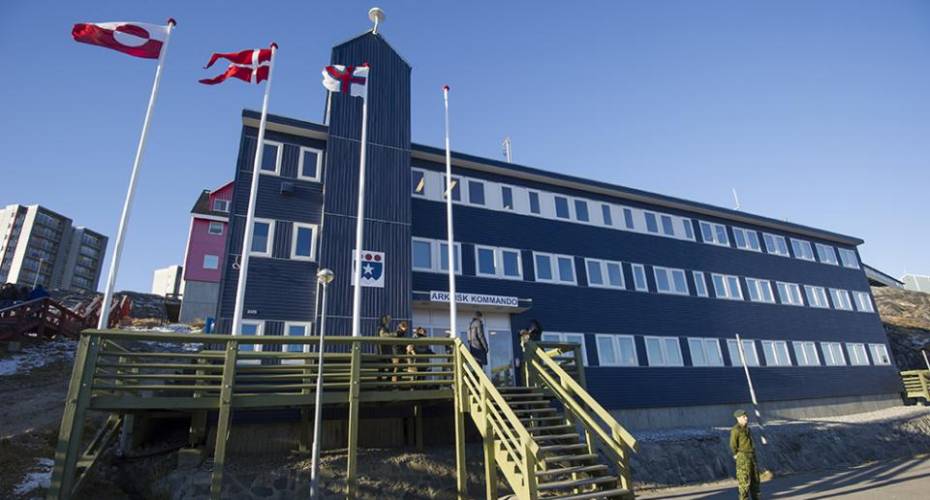
Against a backdrop of protests against the forced abduction of kalaallit children in Denmark, Kalaallit Nunaat’s Prime Minister Múte B. Egede described the campaign to sterilize kalaallit women and girls in the 1960-70s as “genocide for which Denmark should apologize” (DR, December 12). For the president of the Inuit Circumpolar Council, Sara Olsvig, “the individual human rights of girls and women have undoubtedly been violated”, and Denmark must finally take responsibility for its colonial behavior (Altinget, December 17). In a press release, Naleraq president Pele Broberg demanded that the government follow up its accusations with concrete legal measures (Sermitsiaq, December 22). While Donald Trump again raised the idea of US “ownership and control” of Kalaallit Nunaat (DR, December 23), Danish Defense Minister Troels Lund Poulsen announced new defense investments in the Arctic: two new Thetis-class inspection ships, two new long-range drones, two new sled teams for the Sirius patrol and more personnel at Arctic Command (DR, December 24). In Kalaallit Nunaat, Donald Trump’s announcement of the appointment of a new US ambassador to Denmark (Altinget, December 23) provoked strong reactions; for MP Aki-Matilda Høegh-Dam, who represents the kalaaleq party Siumut in the Danish Parliament, “Kalaallit Nunaat is not a commodity or a geostrategic trophy”; “Kalaallit Nunaat is ours. We are not for sale and never will be,” reaffirmed kalaaleq Prime Minister Múte B. Egede (Sermitsiaq, December 23). That said, against the backdrop of a highly deteriorated relationship between Denmark and Kalaallit Nunaat, the kalaaleq Prime Minister also intends to pave the way for further cooperation beyond Denmark, in particular with the USA: “Our foreign policy strategy also means that we cooperate more with our neighbors, because Kalaallit Nunaat must become an independent country”, he said (DR, December 13). Following the intensification of kalaaleq protest in recent months, the Ministry of Foreign Affairs announced that the kalaaleq government would now be responsible for appointing the Arctic ambassador (DR, December 20). Kalaaleq’s Minister of Self-Government and Foreign Affairs, Vivian Motzfeldt, will assume the chairmanship of the Arctic Council on behalf of the Kingdom of Denmark at the political level (Sermitsiaq, December 20). In addition, Kalaallit passports can now show Kalaaleq nationality, not just Danish, which is above all “a powerful symbol of our language, culture and history” for Kuno Fencker, MP for the Siumut party (Altinget, December 16). Finally, after several months in pre-trial detention in Nuuk, the Ministry of Justice decided not to grant Japan’s request for Paul Watson’s extradition, and to release him (Sermitsiaq, December 20).
Photo: IA Generated
Discriminatory Parenting Test, Translation at the Folketing, Inauguration of Nuuk Airport… November’s Wrap-Up
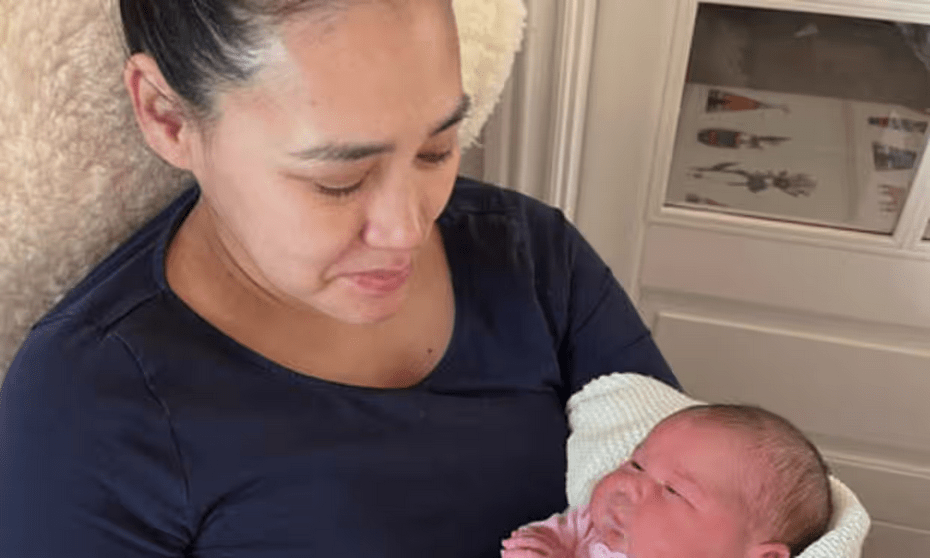
In Kalaallit Nunaat, tensions and demonstrations of support for Keira Alexandra Kronvold, a woman of kalaaleq origin, increased as her child was forcibly taken away by social services within hours of giving birth in Thisted, Denmark. The Danish Parenting Assessment Test (FKU), one of the psychometric tests widely used in Denmark to assess parenting skills, has been heavily criticized for reproducing racist discrimination. An extract from Keira Alexandra Kronvold’s file bears witness to this: “her origin would make it difficult for her to prepare the child for the social expectations and codes necessary in Danish society”. This is just one of many cases, since according to a 2022 report, children of kalaaleq origin living in Denmark are six times more likely to be placed in care than those of Danish origin (Sermitsiaq, November 20; The Guardian, November 25; DR, November 12). At the Folketing, the Danish parliament, the simultaneous translation hitherto rejected by the Speaker, Søren Gade, was tested for the first time during questions to the Prime Minister, Mette Frederiksen, who described the day as historic (Sermitsiaq, November 26; DR, November 26). Another “historic moment” for former Prime Minister Kim Kielsen was the inauguration of Nuuk International Airport, which now provides a direct link between Nuuk and Copenhagen, bypassing Kangerlussuaq (Sermitsiaq, November 28). At the end of November, Danish Defence Minister Troels Lund Poulsen visited Nuuk to meet Foreign Minister Vivian Motzfeldt to discuss the defence agreement and reaffirm a joint commitment to close cooperation on Arctic defence issues, with two priorities: to ensure that the Arctic remains a low-voltage zone, and to guarantee the participation of local businesses and the local population in the development of defence installations (Sermitsiaq, November 23; Eye on the Arctic, November 23). And while Kalaallit Nunaat has already decided to boycott the Nordic Council, the Faroe Islands have also threatened to leave the regional governance body. The Swedish presidency has not invited Kalaallit Nunaat and the Faroe Islands to a number of meetings, seeing this as a breach of equality between Council members, while an update of the treaties is called for so that Kalaallit Nunaat, the Faroe Islands and Åland join the Council as independent members (High North News, November 6). Finally, Paul Watson’s pre-trial detention has once again been renewed until December 18, pending a Danish response as to whether or not he should be extradited to Japan (Sermitsiaq, December 2).
Photo: Keira Alexandra Kronvold and her baby, who has been removed from her by the local municipality. Photograph: supplied (The Guardian).
Oil Spill around Nanortalik, Tsunami, Polar Bears, Merging of Municipalities… September’s Wrap-Up
Following the sinking of the vessel Adolf Jensen, an oil spill of between 15,000 and 20,000 liters of diesel oil occurred in Nanortalik, in the south of the country (DR, September 20). Due to climate change, the occurrence of tsunamis could increase in Kalaallit Nunaat, according to a study that examined the occurrence of a tsunami on the east coast of Kalaallit Nunaat last year (Sermitsiaq, September 13). In addition, a polar bear traveled at least 200 kilometers from Kalaallit Nunaat to Iceland, before being shot by the authorities (DR, September 20). On the domestic front, the merger of municipalities in 2009 has posed major difficulties; in particular, many citizens living outside the main towns of the five main municipalities complain of a lack of local democracy and an over-burdened bureaucracy. A reorganization of the municipalities could be envisaged (Sermitsiaq, September 13). Greenlandic Folketing MP Aki-Matilda Høegh-Dam, who gave a speech in Kalaallisut a year ago, is due to give her speech in her mother tongue again at the opening of the parliamentary session on October 3. However, she has been refused the use of simultaneous interpretation equipment, even though the Folketing has it (DR, September 30). On the subject of the Arctic ambassador, whose appointment had met with profound Greenlandic disagreement last year, the Danish Prime Minister declared that she “wanted to respond” to Kalaallit Nunaat’s wish to have an Arctic ambassador in the country (DR, August 27). Against a backdrop of tension over Kalaallit Nunaat’s in the Nordic Council, Múte B. Egede stated that Kalaallit Nunaat would not participate in the Danish presidency of the Nordic Council of Ministers in 2026 (Altinget, September 12). Meanwhile, more than two months after the arrest of activist Paul Watson, Denmark’s Supreme Court has yet to rule on his detention (DR, October 2). Finally, Air Greenland has announced the creation of new air links between Denmark and Kalaallit Nunaat, with new departures to Nuuk from Aalborg and Billund (DR, September 24).
Revue de mai : le Groenland suspend sa participation au Conseil Nordique, l’UE et les terres rares
Après avoir reçu une fin de non-recevoir de la part de la présidence suédoise du Conseil Nordique quant à la demande de participation pleine du Groenland, des îles Féroé et Åland, Múte B. Egede, le premier ministre groenlandais a mis en suspens sa participation au Conseil Nordique et au Conseil des Ministres nordiques jusqu’à ce que “le respect mutuel et l’égalité” soient rétablis (Naalakkersuisut, 7 mai). Le premier ministre groenlandais a précisé : “Je ne peux pas continuer à participer à des événements où il y a de la discrimination entre les participants.” (Sermitsiaq, 8 mai). Pour rappel, le Conseil Nordique (N5) regroupe le Danemark, la Suède, la Norvège, la Finlande et l’Islande. En 2023, la résidence islandaise avait invité les N8 (N5 + le Groenland, les îles Féroé et Åland) au sommet estival (Altinget, 2 mai). Ce boycott groenlandais doit être compris à la lumière de la nouvelle stratégie étrangère, de sécurité et de défense “Greenland in the world – nothing about us, without us”, dans laquelle le Grenland entend jouer un rôle prédominant dans les instances de gouvernance régionale (voir ici). Plus tôt, le demande pour plus d’égalité au sein du Conseil Nordique formulé par les îles Féroé avait été sèchement rejetée (Altinget, 2 mai). A ce sujet, les îles Féroés ont voté leur nouvelle stratégie arctique dans laquelle est réaffirmée la volonté “d’obtenir une voix indépendante dans toutes les organisations et tous les domaines de coopération concernés” (Eye on the Arctic, 13 mai). Par contraste à la situation au sein du Conseil Nordique, la récente visite d’Ursula von der Leyen aux îles Féroé et au Groenland, et la future présidence danoise du Conseil de l’UE en 2025, augure d’un renforcement de leur coopération avec l’Union Européenne (Altinget, 29 avril). Sur le plan régional, le Groenland pourrait aussi bénéficier d’un rôle accru au sein du Conseil de l’Arctique, lorsque le Danemark en prendra la présidence tournante en 2025 (High North News, 14 mai). La question des matières premières et des terres rares est particulièrement scrutée par les dirigeantes et dirigeants européens, alors que fin 2023, le Naalakkersuisut (gouvernement groenlandais) et l’UE ont conclu un accord de partenariat sur les chaînes de valeur durables pour les matières premières (voir ici). Le Groenland possède 25 des 34 matières premières que la Commission européenne considère comme essentielles pour pouvoir produire, entre autres, des éoliennes et des voitures électriques. Soulignant l’échec de la Chine avec le Groenland à ce sujet, Margrethe Vestager, Commissaire européen à la Concurrence, considère que si des mesures incitatives européennes sont possibles “ce sont les Groenlandais qui doivent décider en premier lieu de la manière dont ils souhaitent que ces ressources soient utilisées. Et il est absolument essentiel que ce soient les Groenlandais qui soient chargés de déterminer comment cela deviendra une réalité” (Altinget, 7 mai). Au Danemark, le parlement a voté un nouvel accord de défense à hauteur de 95 milliards de couronnes sur 2024-2033, lequel prévoit la création d’une brigade prête au combat de 6 000 soldats, l’acquisition d’une défense aérienne basée au sol et l’extension de la conscription à 11 mois (Altinget, 1 mai). Un accord séparé a également été conclu sur l’égalité totale dans la conscription ; les femmes pourront donc être obligées de faire leur service militaire à partir du 1er janvier 2027 (Altinget, 30 avril). Enfin, aux Nations Unis, Sara Olsvig, la porte parole de l’Iuit Circumpolar Council, s’est inquiétée des conséquences de la diminution des contributions des États à l’ONU sur les droits des peuples autochtones (Sermitsiaq, 3 mai). L’an dernier, le rapporteur spécial sur les droits des peuples autochtones, José Francisco Calí Tzay avait dans son rapport dénoncé les discriminations subies par les groenlandaises et les groenlandais dans l’accès à leurs droits, ainsi que les politiques danoises particulièrement violentes (notamment la campagne de stérilisation des filles et des femmes dans les années 1960-70) (voir ici).
– May Review: Greenland suspends its participation in the Nordic Council, the EU and rare earths
After receiving a refusal from the Swedish presidency of the Nordic Council to allow Greenland, the Faroe Islands and Åland to participate fully, Múte B. Egede, Greenland’s prime minister, has put his participation in the Nordic Council and the Nordic Council of Ministers on hold until “mutual respect and equality” are re-established. Egede, the Greenlandic Prime Minister has suspended his participation in the Nordic Council and the Nordic Council of Ministers until “mutual respect and equality” are re-established (Naalakkersuisut, May 7). The Greenlandic Prime Minister clarified, “I cannot continue to participate in events where there is discrimination between participants.” (Sermitsiaq, May 8). The Nordic Council (N5) comprises Denmark, Sweden, Norway, Finland and Iceland. In 2023, the Icelandic residence had invited the N8 (N5 + Greenland, the Faroe Islands and Åland) to the summer summit (Altinget, May 2). This Greenlandic boycott must be understood in the light of the new foreign, security and defense strategy “Greenland in the world – nothing about us, without us”, in which Grenland intends to play a predominant role in regional governance bodies (see here). Earlier, the Faroe Islands’ request for greater equality within the Nordic Council was curtly rejected (Altinget, May 2). On this subject, the Faroe Islands have voted in their new Arctic strategy, which reaffirms the desire “to obtain an independent voice in all relevant organizations and areas of cooperation” (Eye on the Arctic, May 13). In contrast to the situation within the Nordic Council, Ursula von der Leyen’s recent visit to the Faroe Islands and Greenland, and Denmark’s forthcoming presidency of the EU Council in 2025, augurs well for closer cooperation with the European Union (Altinget, April 29). On a regional level, Greenland could also benefit from an enhanced role in the Arctic Council, when Denmark takes over the rotating presidency in 2025 (High North News, May 14). The issue of raw materials and rare earths is under particular scrutiny by European leaders, as at the end of 2023, the Naalakkersuisut (Greenlandic government) and the EU signed a partnership agreement on sustainable value chains for raw materials (see here). Greenland possesses 25 of the 34 raw materials that the European Commission considers essential for the production of wind turbines and electric cars, among other things. Pointing to China’s failure with Greenland in this respect, Margrethe Vestager, European Commissioner for Competition, considers that if European incentives are possible “it is the Greenlanders who must decide in the first instance how they want these resources to be used. And it is absolutely essential that it is the Greenlanders who are responsible for determining how this becomes a reality” (Altinget, May 7). In Denmark, parliament passed a new 95 billion kroner defense agreement for 2024-2033, which includes the creation of a 6,000-strong combat-ready brigade, the acquisition of ground-based air defense and the extension of conscription to 11 months (Altinget, May 1). A separate agreement was also reached on total equality in conscription; women could therefore be obliged to do military service from January 1, 2027 (Altinget, April 30). Finally, at the United Nations, Sara Olsvig, spokeswoman for the Iuit Circumpolar Council, expressed concern about the consequences of the reduction in state contributions to the UN on the rights of indigenous peoples (Sermitsiaq, May 3). Last year, the Special Rapporteur on the Rights of Indigenous Peoples, José Francisco Calí Tzay, denounced in his report the discrimination suffered by Greenlanders in access to their rights, as well as particularly violent Danish policies (notably the campaign to sterilize girls and women in the 1960s-70s) (see here).
Revue d’avril : Discours sur l’Unité du Royaume
Lors du discours sur l’Unité du Royaume, après avoir affirmé la nécessité de former une union forte en Arctique et en Atlantique Nord, la Première ministre Mette Frederiksen a souligné qu’elle était prête à examiner le cadre du Royaume s’il y avait une demande concrète de la part des îles Féroé ou du Groenland. Par ailleurs, la question du poste non pourvu d’Ambassadeur de l’Arctique suite à un désaccord dano-groenlandais n’a pas été mentionné (Sermitsiaq, 19 avril). En parallèle, le Danemark a renforcé son engagement militaire dans l’Atlantique Nord avec cinq nouveaux attachés de défense (un à Ottawa, un à Oslo, un à l’ONU et deux à l’OTAN) (Regard sur l’Arctique, 23 avril). Au parlement danois, un an après son intervention pour demander la traduction des débats en groenlandais, Aki-Matilda Høegh-Dam a décidé de mettre en place son propre système de traduction pour rendre les débats accessibles à ses concitoyens (Altinget, 19 avril).
– April Review: Speech on the Unity of the Kingdom
During her speech on the Unity of the Kingdom, after affirming the need to form a strong union in the Arctic and North Atlantic, Prime Minister Mette Frederiksen stressed that she was ready to examine the framework of the Kingdom if there was a concrete request from the Faroe Islands or Greenland. On the other hand, the issue of the unfilled post of Arctic Ambassador following a Danish-Greenlandic disagreement was not mentioned (Sermitsiaq, April 19). At the same time, Denmark has strengthened its military commitment in the North Atlantic with five new defense attachés (one in Ottawa, one in Oslo, one at the UN and two at NATO) (Regard sur l’Arctique, April 23). In the Danish parliament, a year after she intervened to request the translation of debates into Greenlandic, Aki-Matilda Høegh-Dam decided to set up her own translation system to make debates accessible to her fellow citizens (Altinget, April 19).
Revue de mars : l’UE s’installe à Nuuk, budget militaire accru et l’Etat danois pousuivi par 143 femmes inuit
Au Groenland, après deux ans de préparation, l’Union Européenne par la voix de la présidente de la Commission, Ursula von der Leyen, a officiellement inauguré un bureau à Nuuk le 15 mars dernier. Le nouveau bureau de l’UE devrait contribuer à renforcer la coopération entre l’UE et le Groenland dans de nouveaux domaines prioritaires tels que les matières premières, le climat et l’énergie (Sermitsiaq, 11 mars). L’UE s’est déjà engagée à investir 500 millions d’euros dans le pays d’ici à 2027 (Polar Journal, 14 mars). Pour Ursula von der Leyen, “le fait que l’UE aide à développer l’énorme potentiel du Groenland en matière d’énergies renouvelables et de matières premières critiques est une situation gagnant-gagnant” (Altinget, 15 mars). Sur le plan de la défense, le Danemark, qui avait déjà annoncé l’an dernier tripler ses dépenses militaires sur 10 ans, va augmenter ses dépenses en défense de 5,4 milliards d’euros sur cinq ans. En 2024 et 2025, les dépenses militaires devraient représenter 2,4 % du PIB danois (au-dessus du seuil de 2% fixé par l’OTAN) (Rcinet, 13 mars). Au Groenland, 143 femmes inuit poursuivent le Danemark pour contraception forcée ; le Danemark avait mis en place une campagne de pose forcée de dispositifs contraceptifs intra-utérins dans les années 1960 et 1970 (Rcinet, 5 mars). L’Inuit Circumpolar Council a apporté son plein soutien (Sermitsiaq, 8 mars). Par ailleurs, sur la question du deep-sea mining, le gouvernement groenlandais a annoncé être en accord avec les Nations unies pour mettre en place, par mesure de précaution, une pause pour l’exploitation minière dans les profondeurs des fonds marins (DR, 13 mars). Enfin, les deux navires d’inspection de la marine, qui ont pour mission de patrouiller dans les eaux du Groenland, ont vu leur interdiction de naviguer levée. Les deux navires d’inspection de la classe Knud Rasmussen étaient immobilisés dans le port de Nuuk depuis le 1er février, car les moteurs auxiliaires des deux navires étaient soudainement tombés en panne (DR, 25 mars).
– March Review: EU settles in Nuuk, military budget increased and Danish state pursued by 143 Inuit women
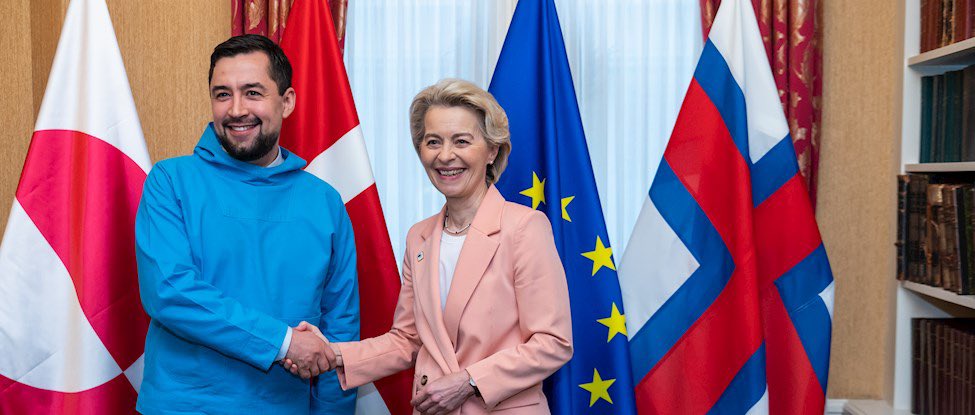
In Greenland, after two years of preparation, the European Union, through the voice of Commission President Ursula von der Leyen, officially inaugurated an office in Nuuk on March 15. The new EU office should help strengthen cooperation between the EU and Greenland in new priority areas such as raw materials, climate and energy (Sermitsiaq, March 11). The EU has already pledged to invest 500 million euros in the country by 2027 (Polar Journal, March 14). For Ursula von der Leyen, “the fact that the EU is helping to develop Greenland’s enormous potential for renewable energies and critical raw materials is a win-win situation” (Altinget, March 15). On the defense front, Denmark, which had already announced last year that it would triple its military spending over 10 years, is to increase its defense spending by 5.4 billion euros over five years. By 2024 and 2025, military spending should represent 2.4% of Danish GDP (above the 2% threshold set by NATO) (Rcinet, March 13). In Greenland, 143 Inuit women sue Denmark for forced contraception; Denmark had implemented a campaign of forced insertion of intrauterine contraceptive devices in the 1960s and 1970s (Rcinet, March 5). The Inuit Circumpolar Council lent its full support (Sermitsiaq, March 8). Meanwhile, on the issue of deep-sea mining, the Greenland government announced that it had agreed with the United Nations to introduce a precautionary pause for deep-sea mining (DR, March 13). Finally, the two navy inspection vessels, whose mission is to patrol Greenland’s waters, have had their sailing ban lifted. The two Knud Rasmussen-class inspection vessels had been immobilized in the port of Nuuk since February 1, when their auxiliary engines suddenly failed (DR, March 25).
Revue d’octobre : nouvelle coalition, représentation à l’OTAN et premier discours en Kalaallisut au Folketing
A la suite de la réélection d’Erik Jensen à la tête du Siumut cet été, Mete B. Egede (IA) a formé un nouveau gouvernement de coalition avec le Siumut, dans lequel chacun des deux partis se partage les portefeuilles ; Erik Jensen sera chargé des finances. Le nouvel accord de coalition s’appuie sur quatre point-clés : le soutien au système de santé publique qui reste défaillant et qui souffre de sous-effectifs, une réforme de la taxation notamment en lien avec le tourisme, le désir partagé de construire l’indépendance par la création d’un département pour l’indépendance et, finalement, une stratégie pour le développement des matières premières et l’exploitation minière (Altinget, 2 octobre). A l’échelle internationale, des représentants groenlandais ont participé pour la première fois à la réunion de l’OTAN qui s’est tenue à Copenhague, ce qui démontre, selon Pele Broberg, un acte de reconnaissance vis-à-vis du Groenland, qui se positionne comme un acteur stratégique en Arctique (Sermitsiaq, 7 octobre). Le Groenland a également officiellement mis en place une représentation à Beijing, au cours de la visite de la ministre des Affaires étrangères et pour l’indépendance, Vivian Motzfeldt (Sermitsiaq, 20 octobre, Sermitsiaq, 23 octobre). Au Danemark, après la rentrée du Folketing, Markus E. Olsen, suppléant d’Aki-Matilda Høegh-Dam a tenu un discours historique, le premier en kalaallisut (groenlandais de l’Ouest) au sein de l’hémicycle. Il a notamment souligné : “même dans notre propre pays, nous sommes traités comme des étrangers, car le danois est parlé principalement dans les administrations publiques” (Sermitsiaq, 5 octobre). Sur le plan régional, le Canada et le Groenland ont signé une lettre d’intention sur une aire marine de conservation dans l’Arctique. Pour Sara Olsvig, présidente de l’Inuit Circumpolar Council, “cette initiative offre une occasion unique pour renforcer conjointement la conservation marine menée par les Inuit et élaborer de nouvelles approches dans lesquelles les Inuit participent à la gouvernance marine et à la définition des opportunités futures” (Eye On the Arctic, 19 octobre, Sermitsiaq, 20 octobre). L’ICC a par ailleurs enjoint le Groenland de révoquer sa réserve territoriale et d’adhérer à l’Accord de Paris, lequel a constitué un tournant dans la participation des organisations autochtones (Sermitsiaq, 10 octobre).
– October review: new coalition, NATO representation and first speech in Kalaallisut at the Folketing
Following Erik Jensen’s re-election as Siumut leader this summer, Mete B. Egede (IA) has formed a new coalition government with Siumut, in which both parties share portfolios; Erik Jensen will be in charge of finance. The new coalition agreement is based on four key points: support for the public health system, which remains deficient and suffers from understaffing; tax reform, particularly in relation to tourism; the shared desire to build independence by creating a department for independence; and, finally, a strategy for the development of raw materials and mining (Altinget, October 2). Internationally, Greenlandic representatives took part for the first time in the NATO meeting in Copenhagen, which Pele Broberg sees as an act of recognition of Greenland’s position as a strategic player in the Arctic (Sermitsiaq, October 7). Greenland also officially set up a representation in Beijing, during the visit of the Minister for Foreign Affairs and Independence, Vivian Motzfeldt (Sermitsiaq, October 20, Sermitsiaq, October 23). In Denmark, Markus E. Olsen, Aki-Matilda Høegh-Dam’s deputy, made a historic speech after the Folketing was called back into session, the first in Kalaallisut (West Greenlandic) to be given in the hemicycle. He pointed out that “even in our own country, we are treated as foreigners, as Danish is spoken mainly in public administration” (Sermitsiaq, October 5). On a regional level, Canada and Greenland have signed a letter of intent for a marine conservation area in the Arctic. For Sara Olsvig, President of the Inuit Circumpolar Council, “this initiative offers a unique opportunity to jointly strengthen Inuit-led marine conservation and develop new approaches in which Inuit participate in marine governance and in defining future opportunities” (Eye On the Arctic, October 19, Sermitsiaq, October 20). The ICC also urged Greenland to revoke its territorial reserve and join the Paris Agreement, which marked a turning point in the involvement of indigenous organizations (Sermitsiaq, October 10).
Revue de septembre : Rapport spécial de l’ONU, plurilinguisme au Folketing et Ocean Explorer
Le rapporteur spécial sur les droits des peuples autochtones, José Francisco Calí Tzay a rendu son rapport à la suite de sa visite au Groenland en février dernier. Le rapport pointe notamment les discriminations subies par les groenlandaises et les groenlandais dans l’accès à leurs droits, ainsi que les politiques danoises particulièrement violentes (notamment la campagne de stérilisation des filles et des femmes dans les années 1960-70) qui ont suivies la période coloniale, qui s’est formellement achevée en 1953. Le rapporteur préconise d’engager “un processus de réconciliation afin d’aborder l’héritage du colonialisme et du racisme et, avec la participation des Inuit, d’élaborer des solutions et des politiques efficaces” (UN, 11 septembre). Un autre préconisation rejoint la demande exprimée au Folketing, le parlement danois, par Aki-Matilda Høegh-Dam de pouvoir s’exprimer en groenlandais et féroïens. A ce sujet, le président du Folketing, Søren Gade, qui s’était montré favorable à la mise à disposition d’interprètes, a finalement tranché, il s’agira pour les membres élus du Groenland et des îles Féroé de traduire eux-mêmes leurs discours au Folketing s’ils s’expriment dans leur langue maternelle. Certaines déclarations et rapports seront également traduits (DR, 21 septembre). Alors que le développement du tourisme de croisière s’est développé considérablement au Groenland ces dernières années et que le gouvernement groenlandais étudie la mise en place d’une taxe pour les passagers (KNR, 31 août), au début du mois de septembre, le navire de croisière Ocean Explorer s’est échoué avec 206 personnes à bord dans l’Alpefjord au nord-est du Groenland. Les passagers ont pu être secourus avec le concours du navire de recherche Tarajoq de l’Institut de la nature (DR, 14 septembre). “Les navires de croisière qui naviguent dans les eaux groenlandaises et dans les fjords ont tous obtenu l’autorisation de naviguer dans nos eaux” précise Vivian Motzfeldt, nouvelle ministre des affaires étrangères et de l’indépendance, “mais la situation qui s’est créée montre clairement que nous devons travailler pour garantir des exigences légales strictes, claires et sans ambiguïté à partir de la saison prochaine” (Sermitsiaq, 13 septembre).
– September review: UN Special Report, multilingualism at the Folketing and Ocean Explorer
The Special Rapporteur on the rights of indigenous peoples, José Francisco Calí Tzay, issued his report following his visit to Greenland last February. The report highlights the discrimination suffered by Greenlanders in accessing their rights, as well as the particularly violent Danish policies (notably the campaign to sterilize girls and women in the 1960s and 70s) that followed the colonial period, which formally ended in 1953. The rapporteur calls for “a process of reconciliation to address the legacy of colonialism and racism and, with the participation of the Inuit, to develop effective solutions and policies” (UN, September 11). Another recommendation is in line with Aki-Matilda Høegh-Dam’s request to the Folketing, the Danish parliament, to be able to express herself in Greenlandic and Faroese. Folketing President Søren Gade, who had been in favor of providing interpreters, has now decided that elected members from Greenland and the Faroe Islands will be able to translate their speeches to the Folketing themselves if they speak in their mother tongue. Certain statements and reports will also be translated (DR, September 21). While cruise tourism has grown considerably in Greenland in recent years, and the Greenlandic government is considering the introduction of a passenger tax (KNR, August 31), in early September the cruise ship Ocean Explorer ran aground with 206 people on board in the Alpefjord in northeast Greenland. The passengers were rescued with the help of the Nature Institute’s research vessel Tarajoq (DR, September 14). “Cruise ships operating in Greenlandic waters and fjords have all obtained permission to sail in our waters,” says Vivian Motzfeldt, the new Minister for Foreign Affairs and Independence, “but the situation that has arisen clearly shows that we must work to ensure strict, clear and unambiguous legal requirements from next season onwards” (Sermitsiaq, September 13).
Revue de juin : Contact Committe, Siumut, Aki-Matilda Høegh-Dam et relations dano-groenlandaises
Le Contact Committee, établi en 2021 comme un forum d’échanges régulier entre le Danemark, le Groenland et les îles Féroé, s’est réuni à Nuuk au début du mois, et a notamment permis de mettre sur la table les tensions dano-groenlandaises exacerbées ces dernier mois (voir ici), de répondre aux exigences de transparence du parlement groenlandais vis-à-vis de la politique étrangère danoise ou encore d’avancer sur la mise en œuvre de l’accord de défense (DR, 6 juin ; DR, 7 juin). La première ministre danoise, Mette Frederiksen, dont le nom est de plus en plus cité comme potentielle future secrétaire générale de l’OTAN (Sermitsiaq, 5 juin), et le ministre des affaires étrangères, Lars Løkke Rasmussen, étaient notamment présents aux côtés de Múte B. Egede et son homologue féroïen, Aksel V. Johannesen. Après plusieurs mois de contestations concernant la nomination d’un ambassadeur de l’Arctique (voir ici), le gouvernement groenlandais a ouvert des discussions quant à la nomination d’un nouvel ambassadeur coopté par le Groenland et/ou par une distribution des postes plus favorables au Groenland à l’avenir (Sermitsiaq, 9 juin). En matière de défense, Troels Lund Poulsen, le ministre danois de la défense, a réaffirmé la centralité de l’Arctique tout en regrettant l’absence de stratégie commune précise à ce stade. L’Arctic capacity package de 2021 prévoyait de créer une formation à la défense sur le sol groenlandais, qui n’a pas été mise en œuvre. Dans l’accord de défense, qui a été présenté par le ministère de la défense à la fin du mois de mai, il est proposé de dépenser 143 milliards de couronnes jusqu’en 2033 (KNR, 7 juin). Sur le plan national, les élections à la tête du parti Siumut pourraient remettre en cause la coalition au pouvoir, et provoquer de nouvelles élections dans les semaines qui viennent, en particulier en cas de victoire d’Aki-Matilda Høegh-Dam (Sermitsiaq, 15 juin). Par ailleurs, cette dernière, élue au Folketing, le parlement danois, vient d’obtenir une réponse favorable de la part de la présidence du parlement à sa demande de reconnaître le féroïen et le groenlandais comme langues officielles au parlement (Sermitsiaq, 14 juin). Après les critiques de Múte B. Egede (voir ici), l’équipe de recherche qui mènera les investigations sur la spiralkampagnen a été mise en place, et devrait rendre ses résultats d’ici deux ans (Sermitsiaq, 30 mai). A ce sujet, la parlementaire groenlandaise au Folketing, Aaja Chemnitz a appelé le gouvernement danois à d’ores et déjà présenter des excuses (Sermitsiaq, 1 juin). En visite au Groenland, Mette Frederiksen, a déclaré : “Je n’ai aucun doute que de graves crimes et erreurs ont été commis dans les relations dano-groenlandaises au fil des ans, même si nous sommes aujourd’hui dans une situation complètement différente” (DK, 7 juin). A ce jour, 163 femmes concernées ont décidé de saisir la justice (Sermitsiaq, 24 juin). Un projet de recherche qui doit faire la lumière sur l’histoire du Danemark au Groenland a également été mise en place en fin de mois (DR, 22 juin). Enfin, suite à la démission de Kuupik Kleist de son poste de président de Inuit Circumpolar Council (ICC) Greenland, notamment en raison des coupes budgétaires décidées par l’Inatsisartut, le parlement groenlandais, Hjalmar Dahl a été élu à la tête de l’organisation qu’il avait déjà dirigée de 2018 à 2022 (Sermitsiaq, 19 juin).
– June review: Contact Committe, Siumut, Aki-Matilda Høegh-Dam and Danish-Greenish relations
The Contact Committee, established in 2021 as a forum for regular exchanges between Denmark, Greenland and the Faroe Islands, met in Nuuk at the beginning of the month, and provided an opportunity to discuss the Danish-Greenlandic tensions that have been exacerbated in recent months (see here), to respond to the Greenlandic parliament’s demands for transparency with regard to Danish foreign policy and to make progress on the implementation of the defence agreement (DR, 6 June; DR, 7 June). The Danish Prime Minister, Mette Frederiksen, whose name is being mentioned more and more as a potential future Secretary General of NATO (Sermitsiaq, 5 June), and the Minister for Foreign Affairs, Lars Løkke Rasmussen, were present alongside Múte B. Egede and her counterpart from Finland. Egede and his Faroese counterpart, Aksel V. Johannesen. After several months of disputes over the appointment of an Arctic ambassador (see here), the Greenland government has opened discussions on the appointment of a new ambassador co-opted by Greenland and/or a distribution of posts more favourable to Greenland in the future (Sermitsiaq, 9 June). On defence, Troels Lund Poulsen, the Danish Defence Minister, reaffirmed the centrality of the Arctic, while regretting the absence of a precise common strategy at this stage. The 2021 Arctic capacity package provided for the creation of defence training on Greenlandic soil, but this has not been implemented. In the defence agreement, which was presented by the Ministry of Defence at the end of May, it is proposed to spend 143 billion kroner until 2033 (KNR, 7 June). At national level, the Siumut party leadership elections could call into question the coalition in power, and provoke new elections in the coming weeks, particularly if Aki-Matilda Høegh-Dam wins (Sermitsiaq, 15 June). Moreover, Høegh-Dam, who was elected to the Folketing, the Danish parliament, has just received a favourable response from the parliamentary presidency to her request to have Faroese and Greenlandic recognised as official languages in parliament (Sermitsiaq, 14 June). Following criticism from Múte B. Egede (see here), the research team that will carry out the investigations into spiralkampagnen has been set up, and is expected to deliver its findings within two years (Sermitsiaq, 30 May). Greenland’s member of parliament in the Folketing, Aaja Chemnitz, has called on the Danish government to apologise (Sermitsiaq, 1 June). On a visit to Greenland, Mette Frederiksen said: “I have no doubt that serious crimes and mistakes have been committed in Danish-Greenlandic relations over the years, even though we are now in a completely different situation” (DK, 7 June). To date, 163 of the women concerned have decided to go to court (Sermitsiaq, 24 June). A research project to shed light on Denmark’s history in Greenland.