
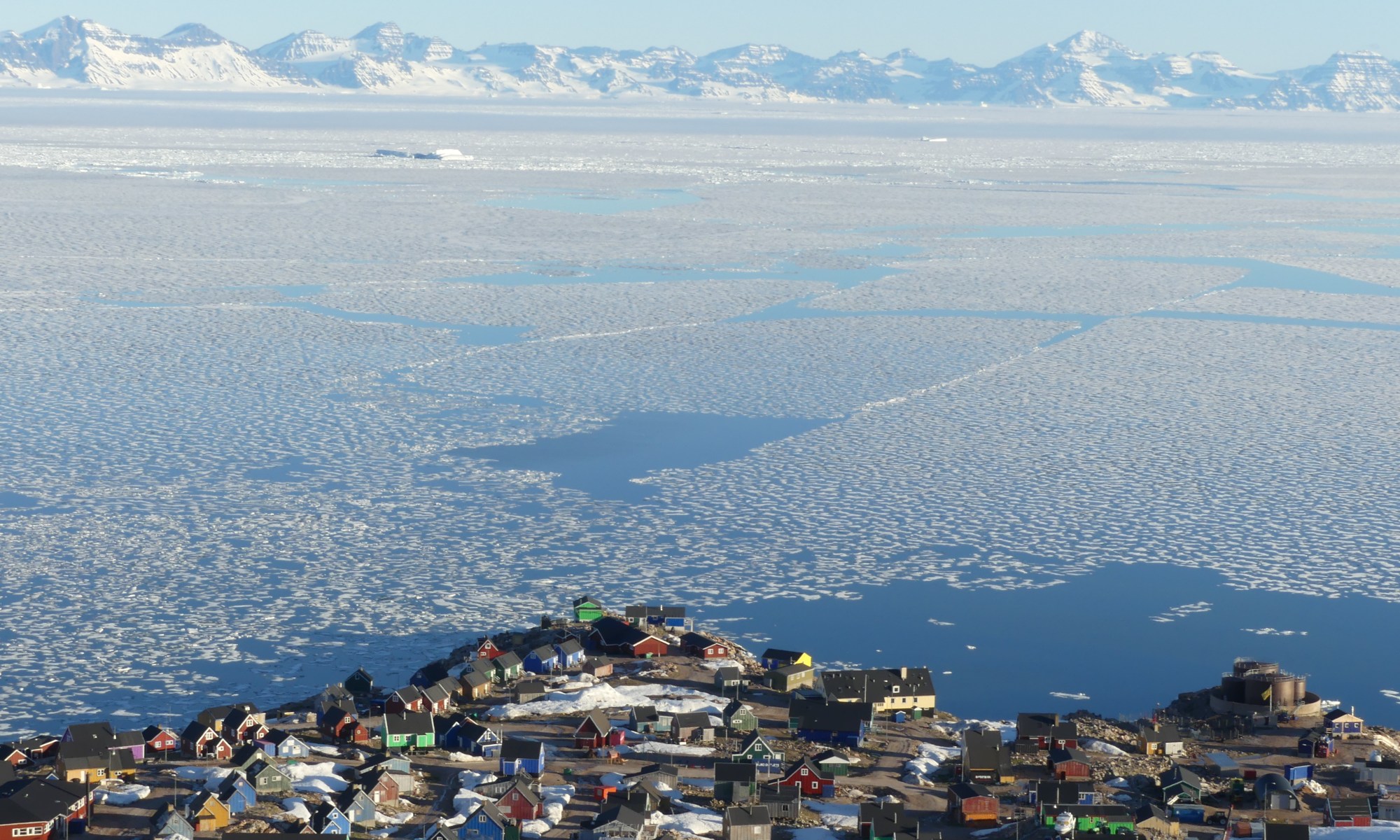
Mapmaking was a crucial means of asserting Western sovereignty over what were perceived as “empty spaces” to be colonized. In East Kalaallit Nunaat in particular, the dispute between Norway and Denmark in the 1920s led to an escalating race between Denmark and Norway to map the east coast as accurately as possible (Arke & Jónsson, 2010, pp. 126–127). In this context, critical mapping is a method used to examine power dynamics, relationships, and spatial distributions that are often invisible or overlooked: “critical cartography challenges academic cartography by linking geographic knowledge with power, and thus is political” (Crampton & Krygier, 2005, p. 11). Following Powell (2010), I consider mapping to be a powerful tool for “encountering and (re)presenting empirical material, particularly in the ways that the visual evokes multisensory, and thus an embodied, experience” (p. 549). The critical mapping approach, informed by critical ethnography, is conceived as a form of reiteration of the lived experiences. As Madison (2020) points out, critical ethnography encourages us to “probe other possibilities that challenge institutions, regimes of knowledge, and social practices that limit choices, constrain meaning, and denigrate identities and communities.” (p. 30). Moreover, critical mapping offers a platform for marginalized communities to voice their perspectives and contest dominant narratives, promoting a more inclusive approach to knowledge production (Maharawal & McElroy, 2018). Through these lenses, critical mapping becomes a tool for advocacy, revealing how space and power intersect in complex and multifaceted ways.
The critical map was created with Louise-Marie Jouault, transdisciplinary artist. Critical mapping was here mobilized as a counter-narrative device that has the potential to challenge the imbalance of power maintained by conventional maps that have been and are crucial tools for affirming control and rights over space.
Available upon request: research@tanguysandre.me
References
Arke, P., & Jónsson, S. (2010). Stories from Scoresbysund: Photographs, Colonisation and Mapping.
Crampton, J. W., & Krygier, J. (2005). An Introduction to Critical Cartography. ACME: An International Journal for Critical Geographies, 4(1), Article 1.
Madison, D. S. (2020). Critical ethnography: Method, ethics, and performance (Third Edition). SAGE.
Maharawal, M. M., & McElroy, E. (2018). The Anti-Eviction Mapping Project: Counter Mapping and Oral History toward Bay Area Housing Justice. Annals of the American Association of Geographers, 108(2), 380–389.
Powell, K. (2010). Making Sense of Place: Mapping as a Multisensory Research Method. Qualitative Inquiry, 16(7), 539–555.
 Tanguy Sandré