
Originally published in French in Mediapart. The translation was generated with DeepL.
After the abduction of Nicolas Maduro, President Trump quickly designated the next targets of his imperialist fury. Among these, Greenland, a former US ambition and a constant obsession for Donald Trump. Faced with this new attack, guided by fury as much as a security and mining fantasy, Greenland is once again united in its anti-colonial voice, surrounded by “allies” entangled in the affirmation of an international law with variable geometry.
The desires of President Donald Trump in Greenland have taken credibility in recent days following the kidnapping of Venezuelan President Nicolas Maduro and Cilia Flores on 3 January, illustrating a reaffirmation of an imperialist and interventionist aim free from international law. So, will Greenland soon be renamed “Red, White and Blueland” as Trump proposed? Or are there ears ready to hear the aspirations of a territory always under Danish tutelage more quick to rename itself Nunarput (“our country/territory”) or Inuit Nunaat (“the country/territory of the Inuit”)?
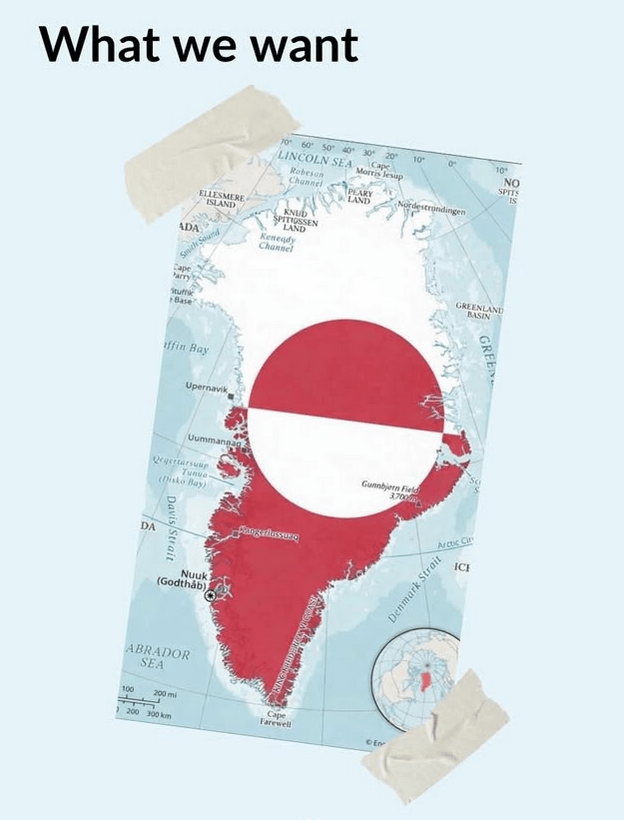
Following the intervention in Venezuela, Kate Miller, the wife of the deputy chief of staff of the White House shared a photo of Greenland against a background of the American flag with the caption “SOON” (SOON). Deputy Chief of Staff Stephen Miller himself claimed that Greenland should be part of the United States. The White House would actively develop acquisition plans, including diplomatic, economic and military measures, calling the autonomous territory a “national security priority” and thus reviving an idea long considered rhetorical. This Trumpian obsession goes back to the first administration but gains in acuity following the US intervention in Venezuela, and while the use of the U.S. military “is still an option” according to the White House.
Silent and then conciliatory after the kidnapping of Nicolas Maduro, Emmanuel Macron and six other leaders and heads of government of NATO member countries signed a joint declaration stating that “it is up to Denmark and Greenland, and on their own, to decide the issues concerning Denmark and Greenland.” The foreign ministers of the Nordic countries (Finland, Sweden, Norway and Iceland) also defended the self-determination of Greenland and Denmark, after obviously not finding the right words to condemn the US violations of international law. As the Danish media outlet Altinget points out, the weakening of European positions vis-à-vis international law, makes any position of support for Greenland inaudible: “international law in Ukraine cannot be defended and its collapse in Venezuela or Gaza cannot be accepted. We cannot talk about sovereignty in the Baltic Sea and ignore it in the Caribbean.” This did not prevent the Danish Prime Minister, Mette Friedriksen, to indicate that any military action would mean the end of NATO: “The international community as we know it, the democratic rules of the game, NATO, the most powerful defensive alliance in the world, all this would collapse if one NATO country decided to attack another.”
But Trump does not only play with the nerves of Europeans as François Bougon points out on Mediapart, he also plays and especially with those of Greenlanders, among whom the desire for independence has never been so shared. Naalakkersuisut President Jens-Frederik Nielsen said in a statement to Trump that: “This is not how we address a people who have repeatedly shown responsibility, stability and loyalty. Too much, that’s too much. No more pressure. No more insinuations. No more annexation fantasies. We are open to dialogue. We are open to discussion.” In a joint statement, all the Greenlandic parties at the Inatsisartut, the national parliament, showed their unity: “as leaders of the Greenlandic parties, we would like to stress once again our wish to see the loss of respect for our country cease to the United States’ disrespect for our country,” they say. Before repeating a formula that has become a refrain in recent months: “We don’t want to be American, we don’t want to be Danish, we want to be Greenlanders.” A position widely, if not unanimously, shared in the country, as I recalled in a previous post. This weekend, this refrain was taken up during a new demonstration in the capital, Nuuk. While responses to US threats have remained largely rhetorical, Greenland MP Aaja Chemnitz at the Folketing, the Danish parliament, is now calling on Greenland and Denmark to take concrete steps, including military measures, regarding the preparation and protection of Greenland.
Earlier in December, Donald Trump appointed a new special envoy to Greenland, the Republican governor of Louisiana state, Jeff Landry. The latter had written on X that it is an honour for him to assume the mission of integrating Greenland into the United States, while the latter has already been present on the territory since the Second World War and that he has a military base in the north of the territory.
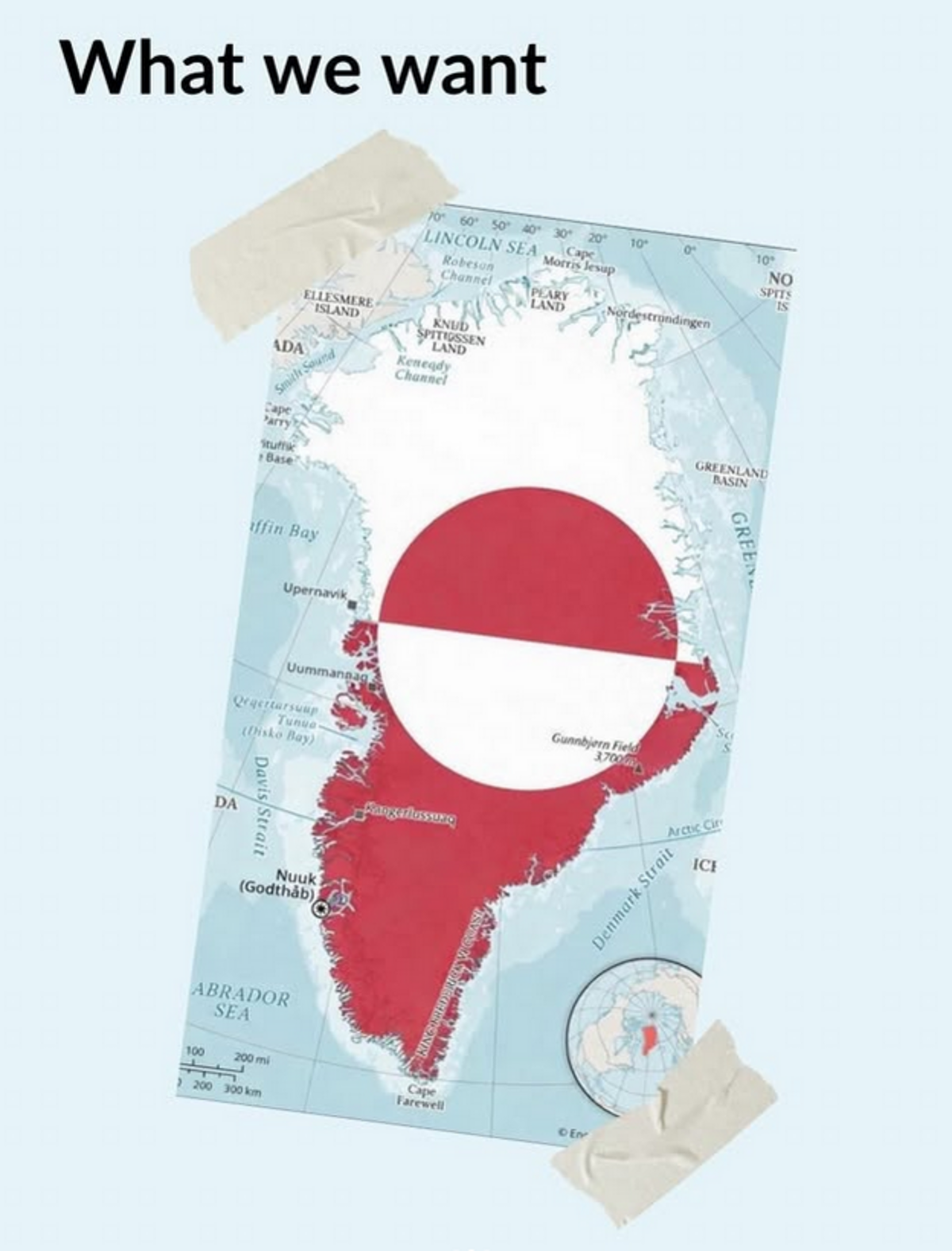
Assembly widely taken up by Greenlanders on social networks to challenge the imperialist and colonial declarations of the United States. © Aka Hansen
In Greenland nothing new: an old American interest
Greenland’s geostrategic position, located between Europe and North America, attracted the attention of the United States very early on. As early as 1867, President Andrew Johnson proposed a first offer to buy the territory, followed in 1946 by that of Harry Truman, who offered 100 million dollars in Copenhagen (Pouilliute, 2025). Already in 2019, President Donald Trump had revived this ambition, again facing the categorical refusal of the Danish authorities.
The US presence in Greenland materialized during the Second World War. In 1941, a treaty allowed the United States to establish military bases on the territory, while Denmark was occupied by Germany. This treaty was updated by a bilateral agreement in 1951, after Denmark joined NATO. This agreement is still the foundation of the US military presence in the territory. The Pituffik base, built in this context, is the only permanent American base in Greenland. It now plays a key role in the U.S. anti-missile system and in its Arctic maritime defence system.
In contrast to Donald Trump’s statements in recent years, diplomatic and military relations between the United States and Denmark and Greenland have strengthened. In 2020, the United States reopened its consulate in Nuuk, after nearly seven decades of absence. First installed in the Arctic command center of the Danish army, this diplomatic representation symbolized Washington’s renewed interest in the Arctic and for increased dialogue with Greenland. In the same year, a cooperation agreement was signed between the United States, Denmark and Greenland, including the management of the services of the Pituffik base. In 2014, the United States unilaterally awarded the contract to a U.S. company, at the expense of a Danish-Greenlandic company, causing strong local reactions. The 2020 agreement now provides that these contracts will have to be awarded to Greenland companies.
The new bilateral defense agreement signed in December 2023 between Copenhagen and Washington provides for the possibility of parking American soldiers and storing equipment on Danish soil. While it explicitly excludes Greenland and the Faroe Islands, it allows unimpeded access by U.S. forces to several bases in mainland Denmark, including Karup, Skrydstrup and Aalborg. More recently, the United States is currently considering transferring Greenland from the European Command (EUCOM) to the Northern Command (NORTHCOM), which, while symbolic, reinforces the perception of a US strategic repositioning in the region.
In this context of geopolitical recomposition, Denmark announced in January 2025 an investment plan of 14.6 billion Danish kroner (about 1.95 billion euros) to strengthen its military presence in the Arctic and the North Atlantic. The plan, developed jointly with the Greenlandic and Faroese governments, involves the acquisition of three Arctic ships capable of carrying drones and helicopters, the deployment of two long-range surveillance drones, and the strengthening of satellite capabilities and land-based sensors to improve situational awareness and intelligence in the region. However, this agreement is considered to be largely insufficient both to allow a defense that is not only dependent on the United States, but also to take the measure of the Greenlandic will to independence. The latter is based in part on the development of a mining sector, whose revenues would be able to replace the Danish subsidy. The current state of mining development in Greenland, as well as the critical and careful approach of Greenlanders to the development of extractivist infrastructure, makes Trumpian geological ambition sparking.
In the background, the mining fantasy
In 2009, with the entry into force of the Enhanced Autonomy Act, Greenland gained full control of its natural resources, including hydrocarbons and minerals, which were previously within Denmark’s jurisdiction. Since then, resource exploitation has often been promoted by the Greenlandic elites as a potential pillar of economic autonomy, with a view to future independence. Although criticized in the 1980s for its enclave character and negative social impacts, the extractive model was rehabilitated in the 2010s as an instrument of sovereignty (Bailleul, 2023). While in 1988, Greenland had introduced a zero-tolerance policy for uranium mines, in October 2013, the Greenlandic parliament lifted a ban on the extraction of radioactive materials, paving the way for uranium mining by mining companies. The development of the mining sector is now often presented by the authorities as an essential condition for economic independence, a prelude to political independence from the Kingdom of Denmark. The exploitation of these resources would reduce financial dependence on the Danish annual subsidy, which represents about 520 million euros/year, or about 16% of the territory’s GDP. Bailleul (2023) suggests that mining development is part of the construction of an “imagined community”, that is to say in “ideological representations supporting the idea of a homogeneous national people, with common traditions and values, essential for the construction and reproduction of nation-states” (p. 314). The lifting of the ban on the exploitation of uranium mines was instrumental, particularly in the development of the Kuannersuit mining project, led by the Australian company Greenland Minerals and Energy. However, the project was abandoned in 2021 (see a previous post on this subject). The refusal to develop certain mines with high immediate profitability, such as Kuannersuit, nevertheless shows that independence cannot be thought of in purely extractivist terms, and that the construction of such an imagined community is anchored in a long-term vision, ecologically and socially sustainable.
Today, Greenland has 25 of the 34 critical raw materials identified by the EU, attracting international lusts. However, in 2025, only seven mining licenses are active and only two mining operations are in operation in Greenland: the Nalunaq gold mine, near Nanortalik (southwestern Greenland), and the White Mountain /Itilleq anorthosite mine near Kangerlussuaq airport. If the Greenland subsoil attracts increasing attention from Denmark, but also from the European Union, which considers Greenland as a strategic partner, as evidenced by the agreement signed in 2023 as part of its search for autonomy from China, the incomes of mining today represent less than 1% of Greenland’s GDP, and a massive development in the short term is as much politically and economically soudable.
Just yesterday, Donald Trump said he wanted to acquire Greenland, favoring the diplomatic option without resolving himself to give up the option of force. If other scenarios are on the table, such as that of a status of free association with the United States, like what exists with some Pacific island nations, or more far-fetched the payment of 100 000 dollars to those who would accept to join the United States, there is little doubt about the rejection of Greenlanders to adhere to a colonialist and imperialist discourse. On Wednesday, Danish Foreign Minister Lars Løkke Rasmussen and Greenland Foreign Minister Vivian Motzfeldt will meet with US Secretary of State Marco Rubio in Washington. If neither the security of the United States nor the promise of a mining pactole are at stake, the Trumpian desires are certainly explained less by the “psychological necessity” that he evoked than by the red carpet that is unrolled to him. Because the option of weakening international law was chosen by the European continent, at least since the colonial and genocidal war in Gaza, and the “moral fault” renewed by the approval of the intervention in Venezuela, Greenland is now preaching its sovereignty, and that of the oppressed territories, increasingly alone in the North.
Tanguy Sandré
Note: Faced with the growing interest of journalists in the country, and facing both disrespectful and culturally inappropriate solicitations, Aka Hansen, an Inuit artist, has published a guide for journalists who come into contact with Greenland Inuit or on the spot. It is available here.
References
Bailleul, P. (2023). Making nation by the mine? Political history of the mining territories in Greenland. Inuit Studies, 47(1/2), 311–334. https://www.jstor.org/stable/27345308
Pungea, A. (2025). Greenland, a serious subject. National Defence Review, 879(4), 77–82. https://doi.org/10.3917/rdna.879.0077
 Tanguy Sandré