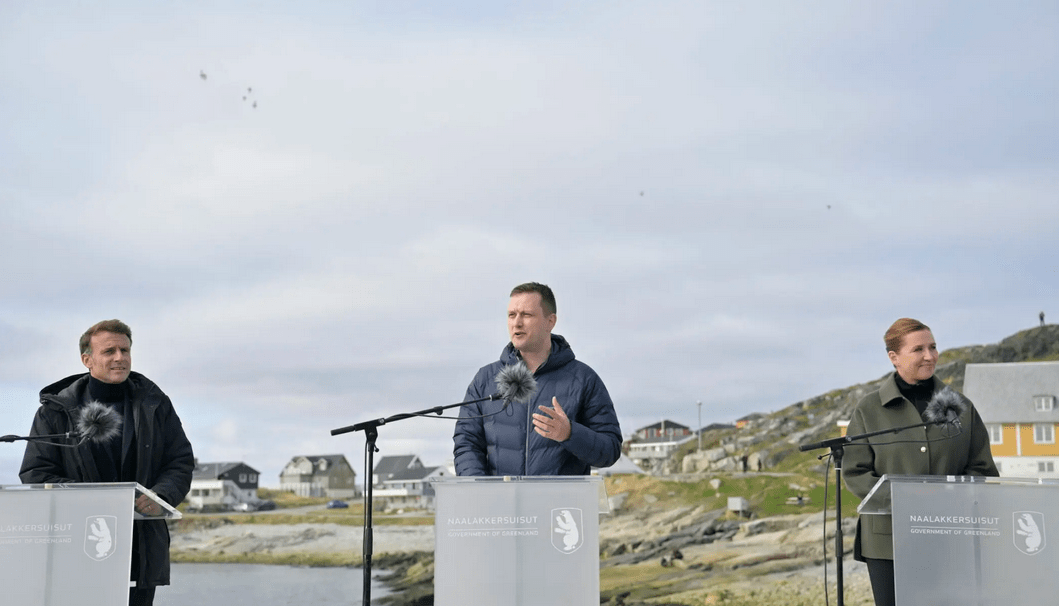
On a visit to Greenland ahead of the G7 in Kananaskis, Canada, the French President met with Danish Prime Minister Mette Frederiksen and Greenlandic Prime Minister Jens-Frederik Nielsen during a visit to Nuuk. Emmanuel Macron affirmed his support for Greenland and announced that France is ready to strengthen its commitment to the Arctic through joint exercises and economic and social partnerships (High North News, June 16). He also announced the opening of a French consulate general in Nuuk, while a European representation was inaugurated in March (Sermitsiaq, June 15). At the end of May, the heads of government of the eight Nordic countries met in Finland. While Greenland, the Faroe Islands, and Åland had been repeatedly excluded in recent months, the eight Nordic countries committed to including them in future Nordic ministerial meetings and to strengthening cooperation on civil preparedness and resilience (High North News, May 30). In mid-June, the heads of government of the Faroe Islands, Greenland, and Denmark convened for their biannual meeting in the Faroese capital, Tórshavn. Beyond increased pressures in the Arctic, the Faroe Islands and Greenland have engaged in dialogue for greater autonomy in foreign affairs, while the Danish prime minister has called for a “modernization of the Kingdom” and greater investment in Greenland (High North News, June 18; Eye on the Arctic, June 17). “We have made it clear that if Greenland wants to amend the Self-Government Act, including ensuring better economic frameworks for Greenland in relation to mineral extraction, we are ready to conclude this agreement on the Danish side,” said Mette Frederiksen (Sermitsiaq, June 17). The head of defense attended this biannual meeting for the first time (Altinget, June 18). In coordination with the Greenlandic government, the Danish armed forces will increase their presence in Greenland this summer, with a frigate and two helicopters now in place to strengthen military operations in the Arctic (High North News, June 11). At the same time, the Danish Parliament approved the installation of US military bases on Danish soil (Eye on the Arctic, June 12). Furthermore, at the NATO summit in The Hague, where the Greenlandic government wanted to meet with their US counterparts (Sermitsiaq, June 23), Denmark formally entered into a partnership with Canada, Germany, and Norway on maritime security and military cooperation in the North Atlantic (Sermitsiaq, June 25). Also in June, Greenland granted a 30-year permit to a European Union-backed project to mine molybdenum, a critical metal used in aerospace, energy, and defense, on which China has imposed export controls. The permit was granted to Greenland Resources, a Toronto-listed company backed by the European Raw Materials Alliance, which holds the license for the Malmbjerg project near Ittoqqortoormiit, the northernmost town on the east coast. The open-pit mine could supply about 25% of Europe’s molybdenum consumption (Sermitsiaq, June 19; Eye on the Arctic , June 19). Regionally, the Kingdom of Denmark held its first session of the Arctic Council; “Engagement with indigenous peoples, focused on promoting knowledge sharing, is a cross-cutting priority for the Kingdom of Denmark,” said Kenneth Høegh, the Greenlandic SAO representing the Kingdom of Denmark (Eye on the Arctic, June 17). Finally, in Denmark, a new organization called Uagut (“us” in Greenlandic) was founded by Greenlanders in Denmark. This organization aims to give a voice to the approximately 17,000 Greenlanders living in Denmark and to combat discrimination against them (Sermitsiaq, June 22).

Researcher in Social & Transdisciplinary Sciences · Critical Environmental Justice & Ethnographies
 Tanguy Sandré