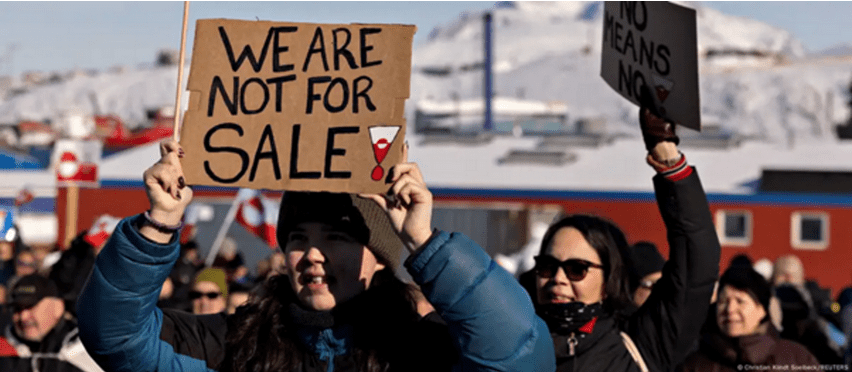
More than 28,000 Greenlanders voted in the March 11 elections to the Inatsisartut, the national parliament, with a turnout of 70.9% (+5 points compared with 2021). A total of six parties competed for the 31 seats in parliament. The social-liberal Demokraatit party (29.9%, 10 seats) (+20.9) came out on top, while the pro-independence Naleraq party won 24.5% of the vote (8 seats) (+12.5). The outgoing coalition of Inuit Ataqatigiit (IA) (15.3%, 7 seats) (-15.3) and Siumut (14.7%, 4 seats) (-14.7) was largely rejected by voters. For its part, Atassut, the only “unionist” party, won 2 seats (7.3% of the vote) (+0.4). Only Qulleq (1.1%), a newly-formed pro-mining, pro-oil extraction party complacent towards Donald Trump, failed to win a seat. The formation of the future government was entrusted to Demokraatit, and its leader Jens Frederik Nielsen, who brought together a broad coalition of all the parties sitting in parliament, with the exception of Naleraq. This coalition agreement, which covers the consolidation of an independence plan, the strengthening of transport, particularly on the east coast, and health, also proposes to defer the most divisive issues, particularly around taxation, raw materials and fisheries, to later agreements (KNR, March 28). On the foreign affairs front, Jens Frederik Nielsen clearly stated the government’s intention to turn its back on Denmark until it can become an independent country (Sermitsiaq, April 1), while he asserted: “Greenland will never be part of the United States. We want to trade. We want a strong national security partnership, of course, but with mutual respect. We will never be for sale and we will never be American” (Reuters, April 1). Parliament will meet on April 7 to approve the coalition agreement, which demonstrates a strong desire for unity in the face of recent external pressure (Sermitsiaq, March 28). Following the coalition agreement, Danish Prime Minister Mette Friederiksen began a three-day visit on April 2, during which she will meet the future Prime Minister (KNR, April 2). This visit has caused a stir within the coalition due to its timing, as the new government has not yet been approved by parliament (KNR, March 31). Earlier, on March 15, a historic demonstration took to the streets of Nuuk, the capital, as well as Sisimiut, the country’s second-largest city, and Qaanaaq, in the north-west of the country, not far from the US military base at Pituffik (formerly Thule) (Sermitsiaq, March 15). A demonstration where numerous signs addressed Trump: “No Means No!” [No means No!], “We Are Not For Sale!” [or “Make America Go Away!” [or “Make America Go Away!] A demonstration described as massive in a country of 57,000 inhabitants, during which many Greenlandic flags were waved by the demonstrators. The demonstration followed Donald Trump’s speech to Congress, in which he reiterated for the umpteenth time since his inauguration that the United States would take control of Greenland “one way or another”, making it clear that he had no intention of letting the autonomous Danish territory down (High North News, March 5). A demonstration with similar slogans also took place on March 31, in front of the American Embassy in Copenhagen (KNR, March 31). This followed on directly from the visit of a US delegation, comprising JD Vance’s wife Usha Vance, US National Security Advisor Mike Waltz, Energy Secretary Chris Wright and Utah Republican Senator Mike Lee, without an official invitation, which further strained diplomatic relations with the USA (KNR, March 28). Although the delegation only visited the US base at Pituffik, and not Nuuk and Sisimiut, Vice President JD Vance joined the delegation at the last minute from March 27 to 29. At a press conference, he declared that Denmark had not “done a good job” for the people of Greenland, nor had it done enough to ensure Greenland’s security (Sermitsiaq , April 1; The Guardian, March 31). Finally, elections for the country’s five municipalities were held on April 1. Siumut, which had largely lost the parliamentary elections, came out on top, while IA lost ground and Demokraatit benefited from the momentum of the parliamentary elections (Sermitsiaq, April 2). The election, which was marked by a feminization of political life (Altinget, April 2), also gave voice to issues that the legislative elections had neglected: the desire for decentralization, education issues and care for the elderly (KNR, April 1).

Researcher in Social & Transdisciplinary Sciences · Critical Environmental Justice & Ethnographies
 Tanguy Sandré